Sunday, 16 June 2024


                                  SOMAWATHI STUPA


The Somawathiya Chaitya is a significant Buddhist stupa in Polonnaruwa, Sri Lanka. It is considered one of the country's most sacred sites and attracts numerous visitors annually. The stupa is believed to have been built more than 2000 years ago and is named after Princess Somawathi, the sister of King Kavantissa and the wife of the regional ruler Prince Giri Abhaya.


Historical Significance

The stupa is believed to have been built during the reign of King Kavantissa, who ruled Magama before the time of Dutugemunu. It is said to enshrine the right canine tooth relic of the Buddha, one of the four most sacred relics for Buddhists. As a result, the stupa is considered an important religious site in Sri Lanka.

In 1987 a group of LTTE terrorists attacked this holy ground hacking to death a Buddhist monk and seven civilians who were residing in a close by temple. Learning this news from a Muslim civilian the pilgrims and the monks in Somawathi went into hiding in the jungle and after several days walked to a temple on November 13,  1987. The terrorists came to the Somawathi and found it deserted. They stole the “Chuda Manikya” (the large gemstone placed at the pinnacle of the stupa) and dug a hole about 1½ feet deep into the stupa in search of valuable relics. Then they marched into a Sinhalese village nearby where a man called S. Dissanayake lived. He was the caretaker of the holy site since 1966. The (LTTE) terrorists hacked to death 10 civilians in this village including S. Dissanayake and his four children. On the same day, the leader of this barbaric terror group died in the stupa by mistakenly firing his own weapon. For some mysterious reason, they also couldn’t take the “Chuda Manikya” they stole which was later found by the archaeological department


                          SRIPADAYA 

 
Siri pada is a beautiful mountain located between Ratnapura district(Sabaragamuwa Province) and Nuwara Eliya (Central Province).it also called ‘Samanala Kanda’, ‘ Adam’s peak’. The top of the mountain has a footprint of Lode Buddha.so Siri pada is the most sacred place of Sri Lankan Buddhists. Siri pada mountant can access in 6 different Routes. Hatton Nallathanni Road, Rathnapura Palabaddara, Kuruwita Erathna, Maliboda,Mukkuwaththa,Rajamale.


Historical value  

According to Sri Lanka’s great chronicle, Mahawamsa, Buddha visited Sri Lanka three times. The last time he traveled from Kelaniya to Sri Pada, and then to Digavaphi thus consisted in the Solosmasthana of Sri Lanka. It is said that Buddha left his footprint on the rock at the peak of the mountain at the invitation of the Deity Saman.

The soles of the Buddha’s feet are said to be flat with all the toes of equal length. On each sole, there are one hundred and eight auspicious marks (mangala­ lakkhana), with the wheel (chakra) as the principal mark at the center while around it are grouped figures of animals, inhabitants of various worlds, and other kinds of symbols.

Buddhists knew that this mysterious footprint had been made by the Buddha long before (as far as the 1st century BC) any other religion was introduced to the country. But in succeeding centuries other faiths, Islam, Hinduism, and Christianity were to lay claim to it. Muslims believe the footprint to be that of Adam (hence the name Adam’s Peak); Christians, that of St. Thomas, the disciple Jesus; and Hindus, that of the god Siva. The Tamil name of the rock Civan-oli-pata (the mountain path of Siva’s light) or Svargarohanam


Sripada season

The Sri Pada season starts from the full moon of December and ends on the full moon of April. Generally, it takes about five to six hours to climb to the top. During this season many shops pop up on the way to the mountain top offering all sorts of food and refreshments. There are first aid centers manned by volunteers on the way. Most people climb by night to reach the mountain top to watch the “Ira Sevaya”, the sunrise over the sea. But this time can be quite crowded, especially during the weekend and towards the end of the season. It’s not rare were you have to spend 5-10 minutes standing on a single step until the crowd moves on. The top of the mountain is quite windy and chilly.


                                          EMBEKKE


Where is it situated?


Embekke Devalaya is situated in Medapalata Korale of Udunuwara in Kandy District. This is a sheltered place used to rest during long pilgrimage or long journeys in ancient days of Sri Lanka. This Ambalama is said to be built during AD 1341–1357 by the King Bhuwanekabahu.


Wood carvings of Embekke Devalaya

The most noticeable feature of the Embekke Devalaya is the carvings on the wooden pillars. There are various images carved into the sides of these pillars. The specialty of these carvings is each of them is different from one another. When we consider the carvings of the entire Devala complex, there are about 125 series of decorations, 256 festoon type designs, and 64 lotus designs, 30 decorative patterns, and roof designs. Thus, there are altogether 514 unique designs.

Out of these famous wood carvings, one of the most recognizable carvings is the Hansa Puttuwa, or entwined Swans. Others include designs of entwined rope (Lanu Gataya), sneezing face (Kisimbi Muna), festoon work (Liyawala), images of Deities (Deva Ruwa), hawk (Gijulihiniya) along with double-headed Eagles, dancing female forms, a mother breastfeeding child, wrestlers, soldiers fighting on horseback, birds with human figures and many more. One of the most unique carvings features an entwined elephant and bull. Here, covering the bull carving with ones hand reveals the whole elephant, and covering the elephant likewise reveals the bull. It is an amazing example of the artistic expertise of Sri Lankan forefathers.


Architectural features of the Embekke Devalaya

The Embekke Devalaya provides an insightful display of the architecture adopted in ancient Sri Lanka. This construction consists of three main sections as the sanctum or Garbhaya in which the image of the God Kataragama has been housed, the Digge or Dancing hall) which is representative of the king consort Henakanda Bandara, and where dancing events were held in the times of the kings and also the final section is the Drummers’ Hall or Hewisi Mandapaya, representing the drummer Rangama who is involved with the back story of its construction and where musical events were once held.

Conclusion

Except for the Sanctum, the rest of the Embekke Devalaya is made almost entirely of wood presenting a breathtaking view for the visitors. The most significant place in this Devalaya complex is the Drummer’s hall due to its architectural features adorned with splendid wood carvings on pillars and doorframes. The building is 52 feet long and 25 feet wide and it is raised with the support of 32 wooden pillars. It is also built on a granite base about 34 inches high.


                            LANKATILAKA  TEMPLE


The Lankatilaka Raja Maha Vihara (also known as the Lankatilaka Temple or the Blue Temple), is located in Hiyarapitiya in the Udunuwara area of Kandy, Sri Lanka’s hill capital. It was constructed as a four storey building that stood eighty feet high and sits on an uneven rock bed overlooking the Hantane mountain range. The history of Lankatilaka Vihara dates back to the Gampola era and was constructed during that time under the patronage of King Buwanekabahu IV in 1344 AD


A magnificent construction on an uneven surface.


The many kings of Sri Lanka with their extravagant and complex desires have often defied nature’s barriers to dictate many splendid creations that belie the imagination ofncommonplace folks. The majestic Lankathilaka Raja Maha Viharaya is one such edifice. It is considered an outstanding architectural construction of the Gampola kingdom. Built at the crest of a large rock, it overlooks the Hantane mountain range in the Hiripitiya hamlet in Udunuwara. The beautiful structure is an amalgamation of Sinhala architecture of the Polonnaruwa period and of Dravidian and Indo Chinese styles, which was an obvious outcome after enlisting the services of South Indian architect Sthapathi Rayer. 


The history of the temple dates back to the 14th century. King Buwanekabahu IV who reigned from 1341 to 1351 CE chose Gampola as his kingdom and commissioned the construction of Lankathilaka. It demonstrates the king’s refined discernment for art and culture and significant contributions to art.

Following the Gedige style of architecture of the Polonnaruwa era, this temple is believed to have consisted of four stories. It has been designed with projecting entrance arches on four sides with elaborate doorways, the main entrance being the most elaborate due to an intricate decoration of figures of celestial and mythical beings. Though the temple seems to have had more levels, what remains today is the ground level structure and an upper storey. Lankathilaka, like many of its counterparts in the Gampola Period is an example of the worship of the Buddha and deities under one roof, a practice of the time.

The main doorway leads to the Image House, from the East with a flight of steps that begins with a simple moonstone. Two Gajasinha balustrades flanked by the sides of the steps leads to an arched doorway. The dragon arch is prominently decorated. The guardian figures on the arch are believed to be similar in character to those at the Tivanka Image House in Polonnaruwa. Elegant architectural design and wall paintings rich in colour, adorn the inner walls and the ceiling of the main Image House. Within the Image House is a magnificent twelve-foot tall Buddha image under a beautiful dragon arch. What is unique about the design of Lankathilaka is that the Image House is surrounded by five devale, with separate entrances, devoted to deities.

Conclusion

The rock inscriptions found in the precincts of the temple is cut into the solid rock. Sections with Sinhala and Tamil inscriptions have been deciphered by archaeologists, which describes the facilities provided to the temple and land gifted by the kings.


                                                MIHINTALE


Where is it situated? 

Mihintale is a mountain peak near Anuradhapura in Sri Lanka. It is believed by Sri Lankans to be the site of a meeting between the Buddhist monk Mahinda and King Dewanampiyathissa which inaugurated the presence of Buddhism in Sri Lanka. It is now a pilgrimage site, and the site of several religious monuments and abandoned structures


Historical Significance


  Why is Mihintale referred to as the birthplace of Buddhism in Sri Lanka?

The literal meaning of Mihintale is “Mahinda’s Hill” – marking the spot where Indian missionary Mahinda met King Devanampiyatissa and converted Him in 247 BC. Buddhism was then firmly embraced by the people of Sri Lanka, making Sinhala Buddhists the prominent state religion in the country.

Why Mihintale is Special?

Mihintale is like the birthplace of Buddhism in Sri Lanka. Legend says a holy man named Mahinda met a king named Devanampiyatissa here way back in the 3rd century BC. This meeting convinced the king to become a Buddhist, and soon Buddhism spread throughout the island. Today, Mihintale is a very important place for Buddhist pilgrims, making it a peaceful and spiritual place to visit


Things to See at Mihintale

  • Mihintale Stupa: This big white stupa is the most important building here. It’s said to be built where Mahinda met the king.
  • Kantaka Cetiya: This stupa has amazing carvings of elephants. It remembers the story of a special elephant sent by Mahinda to King Devanampiyatissa.
  • Kaludiya Pokuna: This is an old bathing pond with beautiful carvings. Monks used it to wash up and meditate.
  • Mahinda Stupa: This smaller stupa is dedicated to Mahinda himself, the holy man who brought Buddhism to Sri Lanka.
  • Caves: Explore the caves where monks used to live and see how simple their life was
Conclusion

Mihintale is more than just old ruins. It’s a place filled with history, religion, and stunning beauty. Follow these tips, explore Mihintale, and experience this special place in Sri Lanka for yourself!


                                ISURUMUNIYA TEMPLE


Isurumuniya is a Buddhist temple situated near to the Tissa Wewa (Tisa tank) in Anuradhapura, SriLanka. There are four carvings of special interest in this Vihara. They are the Isurumuniya lover, Elephant pond and The Royal Family.


Ancient Origins:

  • The temple dates back to prehistory and might have been dedicated to a pre-Buddhist faith of unknown origin.
  • It stands out because its artifacts deviatefrom traditional buddhist styles, making it one of the few places where non-buddhist artifacts were discovered in Anuradhapua's archaeological site.

 Carving of special interest

  • Isurumuniya features four remarkable carvings:
    • Isurumuniya Lovers: A sculptured plaque depicting King Kuvera Vaisrawana and his Queen Kuni. These lovers are believed to be from a different location and were placed here later.
    • Elephant Pond Carving: A low relief carving with four elephants.
    • The Royal Family Carving- Carved on a granite plate, it portrays King Dutugemunu in the center, flanked by two figures fanning him with an WIJINIPATH. 
    • Brahmi inscription- An inscription near the Isurumuniya Lovers plaque, which was originally at a different location, mention the cell of Mahaya being given to Venerable Asalaya.


                          TEMPLE OF TOOTH RELIC


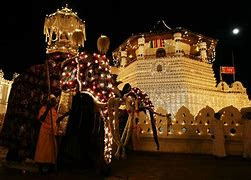
The Sacred Tooth Relic of the Buddha is the most venerated object of worship for Buddhists. Its present house, the Temple of the Tooth Relic in Kandy, Sri Lanka is considered the foremost sacred place of worship in the Buddhist world.


The historical value of the Temple of the tooth relic

As recorded in history, the sacred tooth relic of Lord Buddha was brought to Sri Lanka during the reign of King Kirti Sri Megahavanna (301-328 AD) by Prince Danta and Princess Hemamala from the kingdom of Kalinga, India. Safeguarding the tooth relic had become a responsibility of the monarch, and it was believed that whoever has custody of it would have the right and power to govern the country. Within the ancient capitals, including Anuradhapura, Polonnaruwa, Dambadeniya, Yapahuwa, Kurunegala, Kotte, and Gampola, the remains of the shrines where the tooth relic has been guarded can be seen. So, throughout the ancient monarchs of Sri Lanka, the tooth relic symbolized both religious value and pollical value. During the period of King Wimaladharmasuriya II, another temple of tooth relic was built as a three-storied building instead of the old one at the same location.

With the march of time, this building was decayed and destroyed. Later King Parakrama Narendrasignhe  the successor of King Wimaladharmasuriya II, constructed the temple of Tooth Relic as a two-storied building which we see today. Afterward, the tooth relic was also safeguarded by the South Indian kings called the Nayakkar kings who ruled Sri Lanka within the same shrine. During the time of King Keerthi Sri Rajasinghe, the temple was finely renovated and remodeled to its present appearance. The last king of the ancient Sri Lankan monarch named King Sri Wickrama Rajasinghe  added the surrounding moat and the famous Paththirippuwa or the Octagonal pavilion to the vicinity of the temple from where the king was supposed to have addressed the people. It was believed to be built by Devendra Mulachari, the skilled Architect at the time.


Conclusion

Protecting of the Sacred Tooth Relic and conducting religious rituals without a break is being carried out to the present day under the strict surveillance of the three chief custodians of the Tooth Relic, the most Venerable Mahanayake theros of Malwatta and Asgiriya chapters and the lay custodian, the Diyawadana Nilame.

                                                                   SIGIRIYA Location    Central province Elevation 349 m  Built for King Kas...